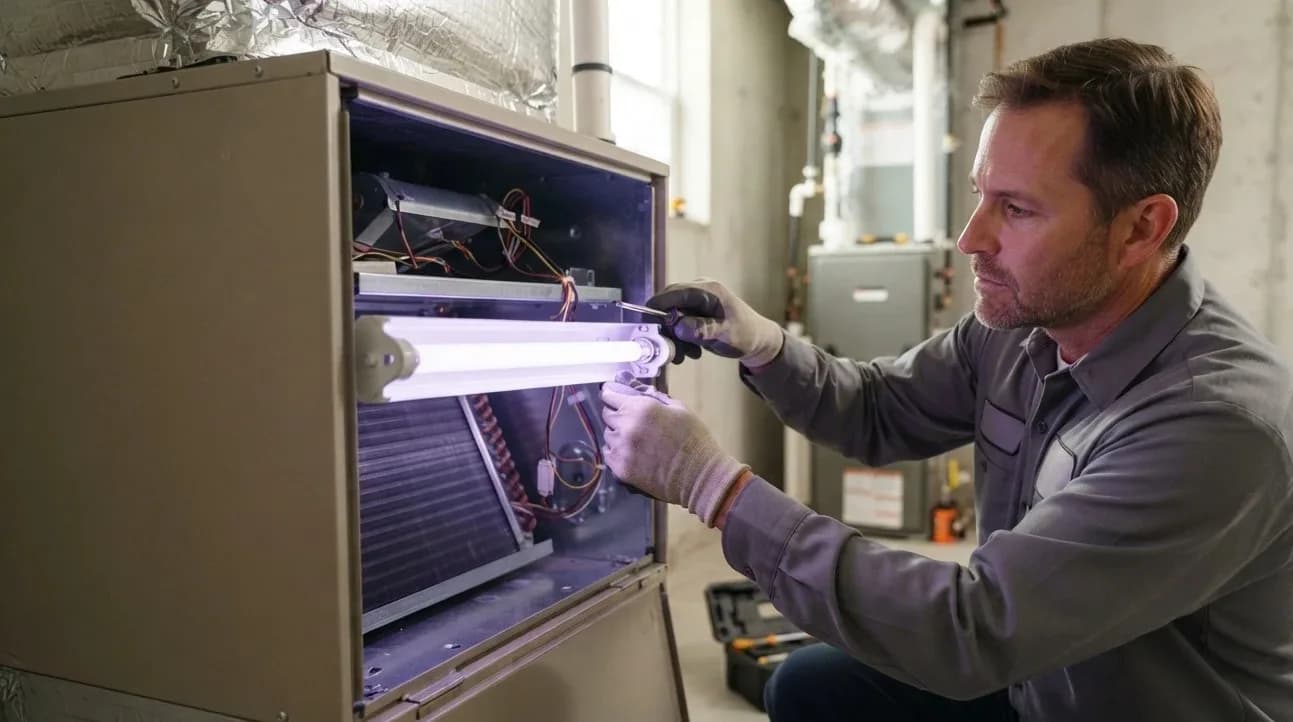
Do UV air purifiers work? Yes, but not in the generic sense that is implied by the term “air purifier”. A UV air purifier installed in your HVAC system can help deactivate certain microorganisms. It can be especially useful for controlling microbial growth on damp HVAC components. But it does not work like a conventional filter.
UV light does not remove dust, pet dander, or pollen from the air. It also does not remove volatile organic compounds (VOCs), which are gases released by products such as paint, adhesives, and some furniture. Its usefulness depends on the system design, UV exposure, and what problem you are trying to solve.
How UV Air Purifiers for HVAC Actually Work
Most HVAC UV air-cleaning systems use UV-C — specifically wavelengths around 254 nanometers (nm) — the short-wavelength portion of ultraviolet light used for germicidal treatment. UV-C can damage the genetic material of microorganisms, interfering with their ability to reproduce and, at sufficient exposure, causing them to become inactive or die.
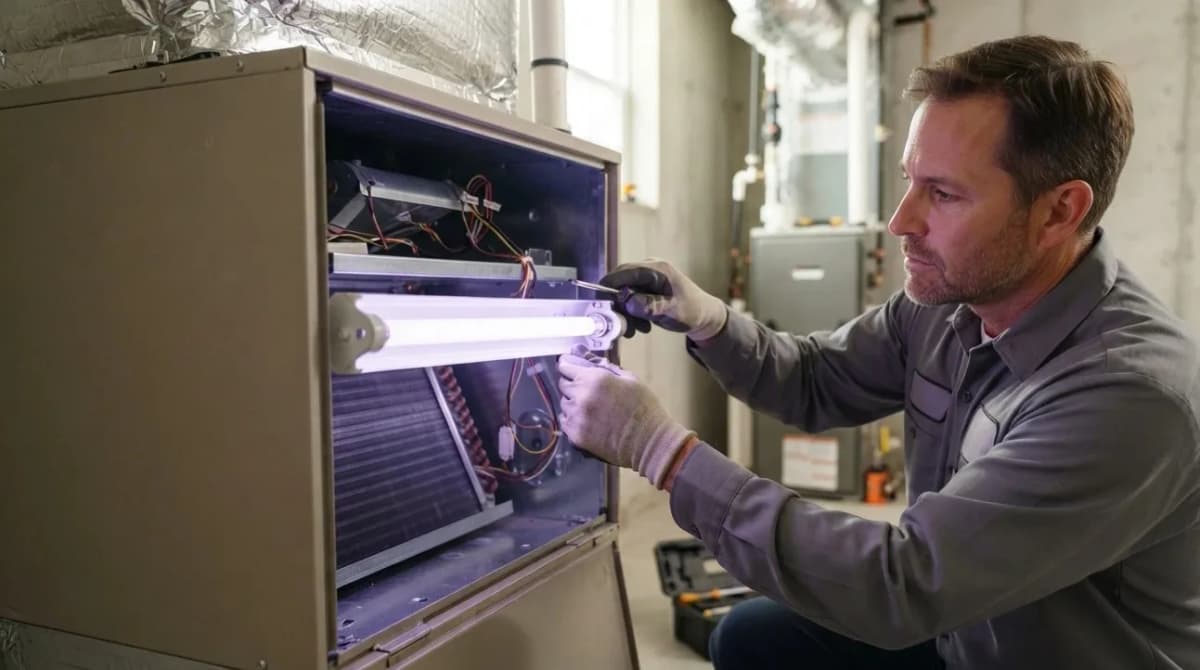
An HVAC UV system can be installed in different ways. Some systems expose the air as it moves through the ducts. Others are placed near components such as the evaporator coil and drain pan.
The two setups work differently. Air moving through a duct may only be exposed to UV light for a short time. A lamp aimed at a stationary surface can provide much longer exposure.
That exposure time matters. According to the EPA, there is a lack of evidence that the UV intensity and exposure time of typical residential UVGI (ultraviolet germicidal irradiation) systems are sufficient to deactivate most airborne microorganisms, including mold and bacterial spores.
So the question to ask is whether a specific HVAC system provides enough UV exposure, at the right locations, to achieve the desired task.
What UV Lights Can Realistically Remove or Reduce
UV treatment is intended to remove biological contaminants and not particles. UVGI can inactivate or inhibit microorganisms (bacteria, some viruses, and some molds) depending on the system and exposure conditions.
A practical use for the home is to control the growth of microbes on HVAC surfaces. Cooling coils and drain pans may be damp while the air conditioner is in use, providing an environment for biological growth. EPA reports that well-designed UVGI systems may inactivate some biological pollutants that can develop on damp HVAC system surfaces, but that the effectiveness of typical residential UVGI systems is limited against some bacteria and molds.
Unlike a filter, this is what distinguishes UV. A filter physically traps the particles when air flows through the filter. UV, on the other hand, deactivates microorganisms that are exposed to sufficient radiation.
Even when UV deactivates a biological particle, it does not necessarily remove it from your home. The EPA points out that while dead or deactivated biological particles may not be active, they can still contain allergens, irritants, or toxins.
What UV Lights Cannot Do
This is the part that gets lost in many UV air-purifier claims.
UV light does not replace particle filtration**.** It will not physically trap dust, pet dander, or pollen that can be picked up by your HVAC system. For this reason, EPA specifically recommends UVGI in addition to the use of conventional particle filtration, rather than as a replacement.
Filtration is the more directly relevant technology if the primary concern is dusting, sneezing around pets, or pollen coming into the house.
UV should not be used as a general VOC remover as well. EPA's residential air-cleaner guidance says there is no evidence that UV disinfection removes gaseous pollutants from indoor air.
Mold has another drawback. UV can help to prevent or kill some microorganisms, but it cannot solve the moisture issue that enabled mold to grow. Even if the mold is growing, the source of moisture and the mold must be dealt with.
Think of the technologies this way:
● UV: targets certain microorganisms. ● Filtration: traps particles in the air that include dust, pollen, and dander. ● Ventilation: replaces indoor air with outdoor air and can help dilute pollutants. ● Moisture control: addresses conditions that provide a foundation for mold and biological growth.
There is no technology that performs all four tasks.
Coil-Sanitizing UV vs. Whole-Air UV Systems
Not all HVAC UV systems are meant for the same application.
A coil sanitizing system is located to ensure that UV energy is delivered to surfaces within the air handler, especially around the cooling coil and drain pan. Its purpose is to inhibit biological growth on those damp surfaces. EPA also indicates that UVGI can be effective at preventing biological growth on HVAC cooling coils and drain pans because of the longer time the surfaces are exposed to UV.
In a whole-air or airstream UV system, the microorganisms pass through the HVAC system. The main challenge is exposure time. Air may pass the lamp quickly, so the system needs enough UV intensity and coverage to work effectively.
CDC guidance distinguishes between coil-treatment UVGI, which is intended to control microbial growth on HVAC coils, drain pans, and other wetted surfaces, and air-treatment UVGI, which uses UV energy to inactivate airborne pathogens as they move through the HVAC duct.
For this reason, the term “whole home purification” is a bit of a false promise when it comes to an HVAC UV lamp. The results are dependent upon lamp output, lamp position, airflow, exposure time, and the design of the system.
What the EPA and CDC Say About UV Air Treatment
EPA supports UVGI as a supplemental air-treatment method. It is not a replacement for filtration. Professionally designed and properly maintained UVGI systems can eliminate certain microbes, and many airborne microbes may not be effectively inactivated with typical residential systems.
EPA also lists HVAC cooling coils and drain pans as useful applications, as they can get more UV exposure time.
CDC also uses UVGI as an additional control to filter or ventilate. The efficacy can differ according to installation, ventilation, exposure, and maintenance.
The lesson to learn: UV can be beneficial, but the term UV alone is not a measure of the effectiveness of an HVAC installation.
Is a UV Air Purifier Worth It for Your Home?
Whether a UV air purifier makes sense depends on what you want it to accomplish.
A properly designed surface-treatment UV system might be useful in instances where the HVAC system has a history of biological growth on damp parts. This is an application where EPA has found UVGI effective because extended exposure time to the target surfaces can be achieved.
If your main problem is dust, pet dander, or pollen, UV should not be your first assumption. Those are particle problems, and filtration is the technology that is used for the capture of particles.
Humidity matters, too. Humidity control may be part of the solution since excess moisture can lead to mold growth. See our guide to humidifiers and dehumidifiers for more on adding and removing indoor moisture.
If you're considering UV because of respiratory illness concerns, remember that EPA and CDC guidance treats UVGI as one component of a broader indoor-air strategy. Ventilation and filtration still matter.
Installation and Maintenance Basics
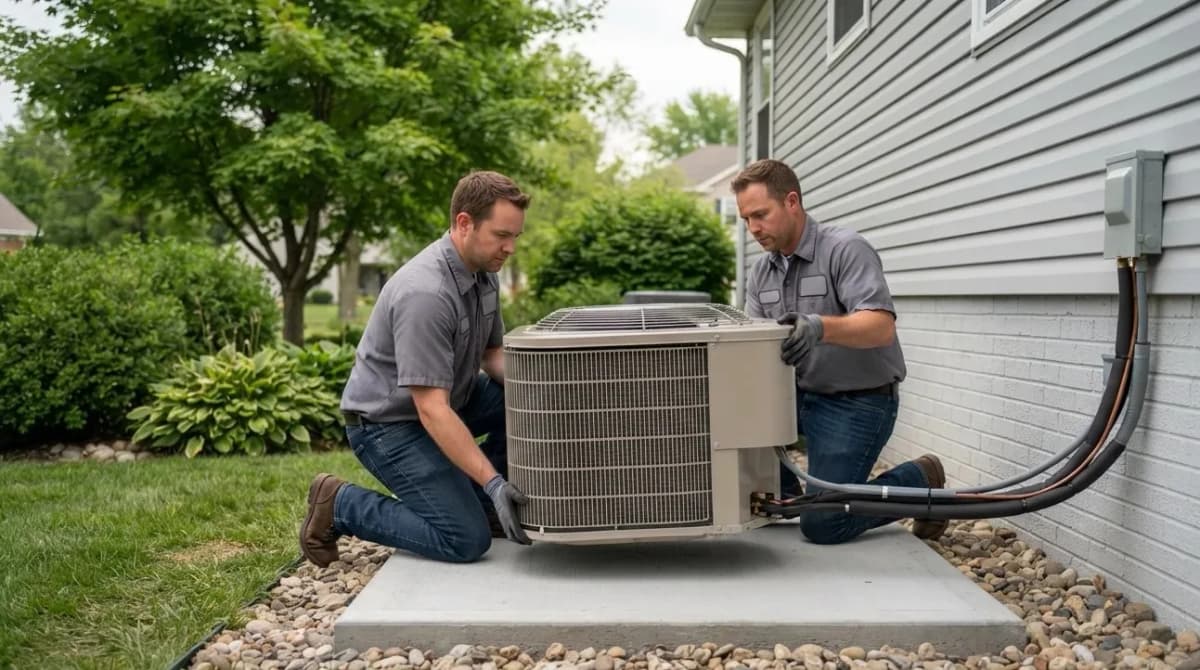
UV-C exposure can damage eyes and skin, so the HVAC UV system should be located so no one will be exposed directly to the lamp. The EPA recommends professionally designed and properly installed systems. Maintenance matters because dust on a lamp can reduce its UV output.
Lamp replacement schedules vary. According to CDC guidance, UV lamps are typically replaced at least once a year, but certain brands may have different recommendations. Follow the manufacturer's schedule for your system.
Before adding a UV system, have an HVAC professional evaluate the equipment, installation location, airflow, and existing filtration.
FAQs
Are UV air purifiers installed in HVAC systems safe?
A properly installed HVAC UVGI system can be safe when direct UV-C exposure is prevented. UV-C can harm the eyes and skin, so the lamp should be enclosed or placed out of reach. EPA recommends professional installation for safe operation.
Do UV lights reduce allergens like dust and pet dander?
Not in the way a particle filter does. UV light cannot trap or remove pet dander and dust. EPA also says there is no research showing UV disinfection reduces dust-mite or mold allergenicity. If you are concerned about allergens, then use particle filtration. UV is just an additional measure.
How long do HVAC UV lights typically last before replacement?
Replace as per the manufacturer's schedule, depending on the lamp and system. According to CDC guidance, UV lamps are typically replaced every year or so, depending on the manufacturer's recommendation (some specify replacement every two years). Cleaning is also necessary, as dust can decrease the output of the UV.
Is installing a UV air purifier worth the cost for most homes?
There is no universal answer. UV may help control biological growth on HVAC surfaces. It can also provide supplemental microbial treatment. However, it does not replace filtration or remove dust and pet dander. The value will differ based on your HVAC system, moisture issues, existing filtration, and the specific issue you are attempting to resolve.