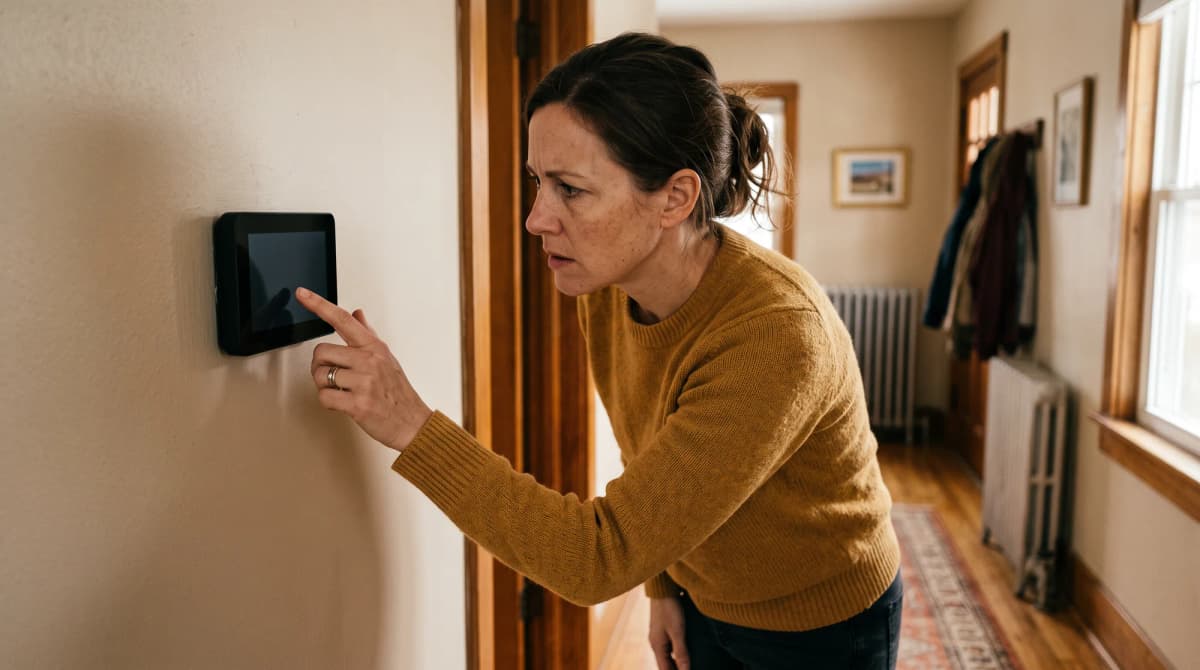
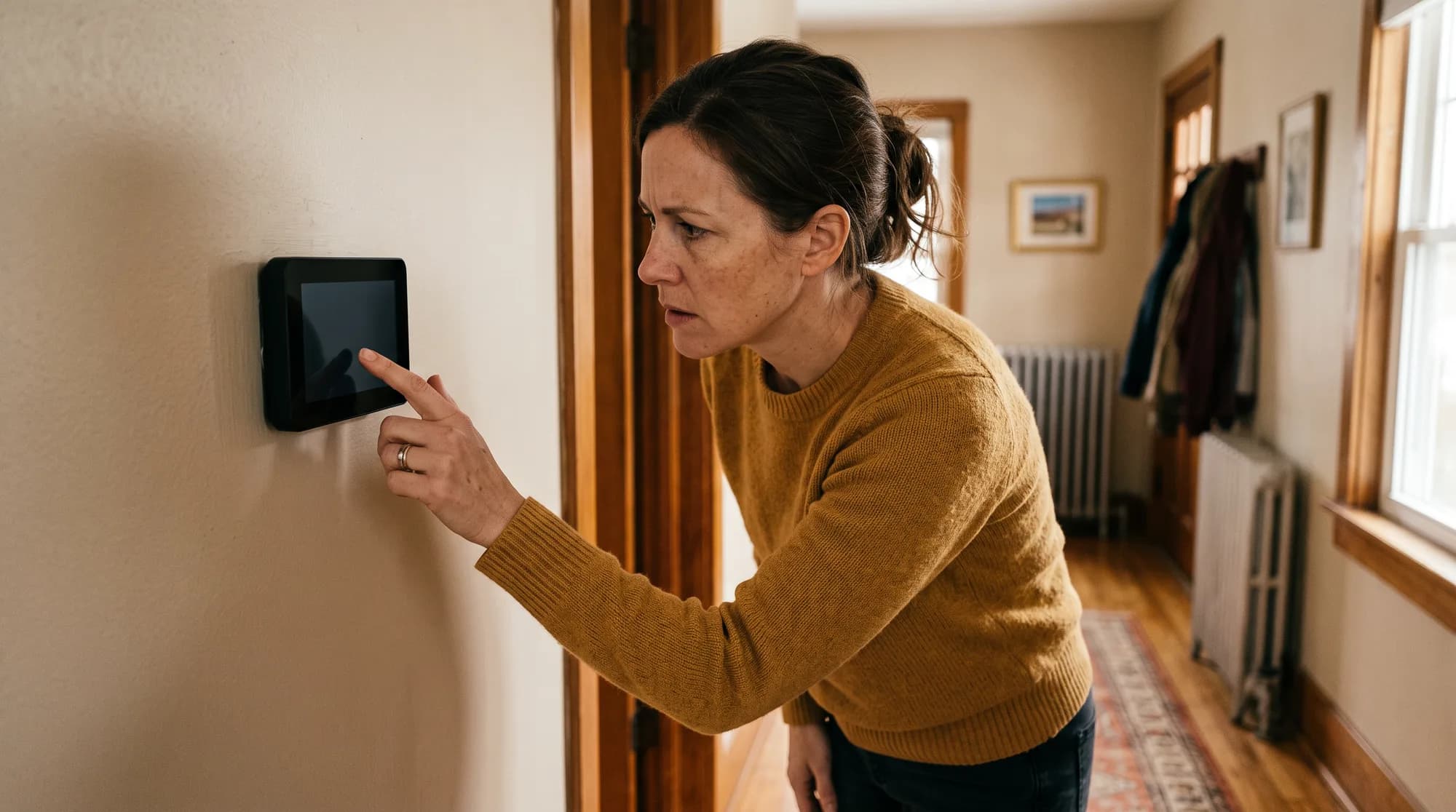
Your thermostat will usually display your home's temperature and heating or cooling controls in real time. When the thermostat screen goes blank, it's easy to think that your HVAC system is no longer working.
That isn't typically the situation. If the display is dark, it may be due to a battery failure, a tripped breaker, a low-voltage fuse, a loose wire, or a smart thermostat power problem. Before replacing the thermostat or assuming you need a major HVAC repair, try these simple checks first.
Quick Checks First
The first step is to determine if your thermostat operates on replaceable batteries or gets electric power from the wiring associated with your HVAC system. There are also some smart thermostats that have specific power requirements, unlike battery-powered ones.
Next, check whether anything else in your home has lost power. If the lights or other equipment are also out, there may be a more serious electrical problem than the thermostat.
If the rest of your home has power but the thermostat is not turning on, continue with the HVAC-specific checks below.
Avoid opening electrical panels or handling exposed wiring. When in doubt, stop and let a qualified HVAC professional take a look at a component or connection.
Common Causes of a Blank Thermostat Screen
Dead or Low Batteries
If your thermostat uses batteries, start there. A battery-powered thermostat can go completely blank when its batteries are low or dead.
Some thermostats will show a low battery warning before turning off; others may just not show anything. Replace the batteries with the type specified by the manufacturer and make sure they are installed correctly.
If the screen comes back after replacing them, you have likely found the cause. If it stays blank, another problem may be interrupting power.
Tripped Breaker or Blown Fuse
A hardwired thermostat requires power from the HVAC control circuit. When the furnace or air handler loses power, the thermostat can lose power too.
Check your home's electrical panel for a breaker that appears tripped. If you can find the HVAC breaker, switch it back on after you read the instructions on the panel.
Never reset a breaker that trips over and over. If the breaker trips immediately, it could mean there is an electrical problem that requires a professional diagnosis.
Blown Low-Voltage (Transformer) Fuse
Many furnaces and air handlers contain a small fuse on the control board that protects the low-voltage circuit. The transformer supplies the lower-voltage power used by controls such as the thermostat.
A short elsewhere in the control wiring can cause this fuse to blow. One reason could be that the thermostat wiring is damaged, pinched, or improperly connected.
If a fuse keeps blowing, replacing it again and again is not a solution. Repeated fuse failure means the underlying electrical problem needs to be identified.
Wiring Issues Behind the Thermostat
A loose or disconnected wire can cause your thermostat's display to stop working, particularly if the thermostat was recently removed or reinstalled.
If the manufacturer's instructions allow it, you may be able to remove the thermostat's faceplate and look for an obviously loose or disconnected wire. Do not pull on wires or attempt to rewire the terminals unless you are qualified to do so.
Even a small wiring mistake can create a larger HVAC control problem, so leave complicated wiring issues to a professional.
Smart Thermostat Losing Power (C-Wire Issues)
Smart thermostats generally need a steady source of electrical power to operate their electronics and connected features. Many installations use a C-wire, or common wire, to provide a continuous return path for power.
If a smart thermostat was installed without the power arrangement its manufacturer requires, it may experience intermittent power problems. The result can be a display that repeatedly turns off and back on.
If your smart thermostat keeps losing power, especially after a recent installation, check the manufacturer's compatibility and wiring requirements. Do not assume that every thermostat works with every HVAC system.
The U.S. Department of Energy has information on programmable and smart thermostat controls and their use in heating and cooling systems.
Thermostat Failure
In some cases, the thermostat itself has malfunctioned. Electronic components can eventually stop working, especially in an older thermostat.
Always rule out batteries, breakers, fuses, and readily apparent wiring issues before replacement. A new thermostat will not solve a problem in another part of the HVAC control circuit.
After some basic checks, a technician can tell if the thermostat is faulty or if it is not getting enough power.
Simple Checks You Can Do Before Calling a Technician
Start with the easiest checks first.
If your thermostat uses batteries, replace them with new batteries recommended by the manufacturer. Then check the electrical panel for a tripped HVAC breaker and reset it once if appropriate.
If the thermostat faceplate comes off easily, you can check for a disconnected wire. Do not touch any exposed electrical components.
You can also check whether the furnace or air handler appears to have power. If both the thermostat and HVAC equipment are unresponsive, the problem may be somewhere in the system's power or control circuit.
Do not repeatedly reset breakers or replace fuses without finding out why they failed. A recurring electrical problem needs proper diagnosis.
When to Call a Professional
Call an HVAC professional if the breaker trips again immediately, a low-voltage fuse repeatedly blows, wiring looks damaged or complicated, or a smart thermostat will not stay powered.
If you don't feel like using the thermostat, or if you have no idea why it's still blank, professional assistance is the right choice.
If you encounter a problem that is beyond these basic homeowner troubleshooting steps, you can use the site's residential HVAC service page to locate a local HVAC technician.
FAQs
Why did my thermostat suddenly stop working with no warning?
A thermostat can suddenly stop working due to lack of batteries, a tripped breaker, a blown low-voltage fuse, loose wiring, or thermostat failure. Wiring failures or compatibility issues can also cause smart thermostats to malfunction. If a basic power breaker inspection does not resolve the display issue, a full diagnosis by a professional may be required.
Do all thermostats run on batteries?
No. Some thermostats use disposable batteries, and others are wired into the HVAC system. Some models have a combination of wired power and battery backup. Check your thermostat's model information or manufacturer's instructions before assuming that dead batteries are causing the blank display.
What does it mean if my smart thermostat keeps losing power?
If a smart thermostat is losing power repeatedly, it could be a wiring, compatibility, or HVAC control power issue. Some models need a C-wire (common wire) to power continuously. The wiring and components of an HVAC system can vary from one model to another, so consult the manufacturer's instructions before making changes.
Can a blank thermostat screen mean my whole HVAC system has failed?
Not necessarily. Dead batteries, tripped breakers, a blown low-voltage fuse, wiring issues, or thermostat malfunction can all result in a blank screen. The display alone does not prove that your furnace or air conditioner has failed. A technician is able to perform a test and determine the source of the power or control issue.